
Ben Laurence
·
·
7 min

TL;DR
For a side project, maybe. For a business that needs to sell, rarely. AI makes a website that looks good enough easy, but it's a mirage. It can't tell you why a page isn't selling or what to fix, and visitors can sense a site nobody really thought about.
Good enough is a mirage
It takes an afternoon now. To get something that looks the part, anyway.
Type what your business does into Claude, ChatGPT or one of the AI website builders, and a few minutes later there's a homepage. Clean layout. A headline that sounds like a headline. For a lot of owners, it looks like the job's done.
It isn't. It's a mirage. From a distance it looks like a website ready to sell. Get close, the way a customer does, and it isn't there.
I get the appeal. But after 20 years of looking at websites, I’ll say this plainly. Looking good enough is now cheap for everyone. When everyone’s standing on the same floor, standing out is worth more than ever.
Where AI earns its keep
To be fair to it, I use AI every day. Research, repetitive tasks, first drafts, rough concepts, sounding out ideas at speed. It makes us faster for clients.
For an owner, it's good for the same things. Getting ideas down. Showing a designer what's in your head instead of describing it.
This website is a good example. AI was in the room the whole way through. Drafting ideas quickly. Talking decisions through. Building a lot of the code behind what you're reading.
But what you're looking at is somewhere around version 300, after 500 or so changes and tweaks. Human ones, made by hand. You should have seen version one. It was a long, long way from this.
Used with care, it's a brilliant tool. The problem is what happens when it's the only thing in the room.
AI raised the floor, not the ceiling
Figma's CEO, Dylan Field, said something on MTS Live that stuck with me. He used to say AI would "lower the floor and raise the ceiling". Then he corrected himself. "We're seeing it lower the floor," he said. "But the ceiling doesn't seem to have changed."
He made another point. "Anything you can verify, AI's great at." Math. Code that either runs or doesn't. Design isn't like that. "You get five designers in a room, they can't agree all the time on exactly what they should do." There's no single right answer for the AI to check itself against.
Ask an AI why your page isn’t selling and it’ll give you ten reasons, all delivered with total confidence. What it can’t tell you is which one is true for your customers. That part has always been judgment.
Why the human in the room matters
An AI will spit something out and think it's great. It often doesn't know what it doesn't know.
What it needs is someone who can push back. Someone who can say: that can't go there, and here's why. That section's missing, and here's what it costs you. That's an obvious design mistake, and here's what a buyer will do when they hit it.
That's what design for selling experience gives you. Not the ability to make a page, but the ability to tell a page what's wrong with it.
Most owners can't be expected to do that. It isn't their job. But it means that, in my experience, 99 times out of 100, launching whatever the AI gave you won't get you anywhere near what your online business could do.
AI is a tool. Like any tool, it’s there for anyone to pick up.
Walk into a hardware store and you can buy a drill, a saw and a level. With those, most people can put up a shelf. Nobody thinks that makes them a carpenter. You wouldn’t open a carpentry business on the back of it, or build your own boat, or trust yourself to build a house.
Having the tools was never the hard part. Knowing how to build something complex with them is. And the website your business runs on isn’t a shelf. It’s the house.
The uncanny valley of websites
You've had this feeling. You land on a site, everything's where it should be, and something's off. You can't name it. You just don't quite believe it.
There's a name for that, and it comes from robots.
In 1970, a Japanese robotics professor, Masahiro Mori, noticed that the more human a robot looks, the more comfortable we are with it. A factory arm, fine. A cartoon robot, fine, even likeable. A real person, we trust.
Then, just short of human, it falls off a cliff. Mori's example was a realistic prosthetic hand that feels cold when you shake it. Comfort doesn't level off. It drops. He called that drop the uncanny valley.
Nearly right. That's the problem. Nobody minds a robot that looks like a robot. What puts people off is something pretending to be what it isn't, and almost getting away with it.
Websites have their own valley, and AI is filling it.
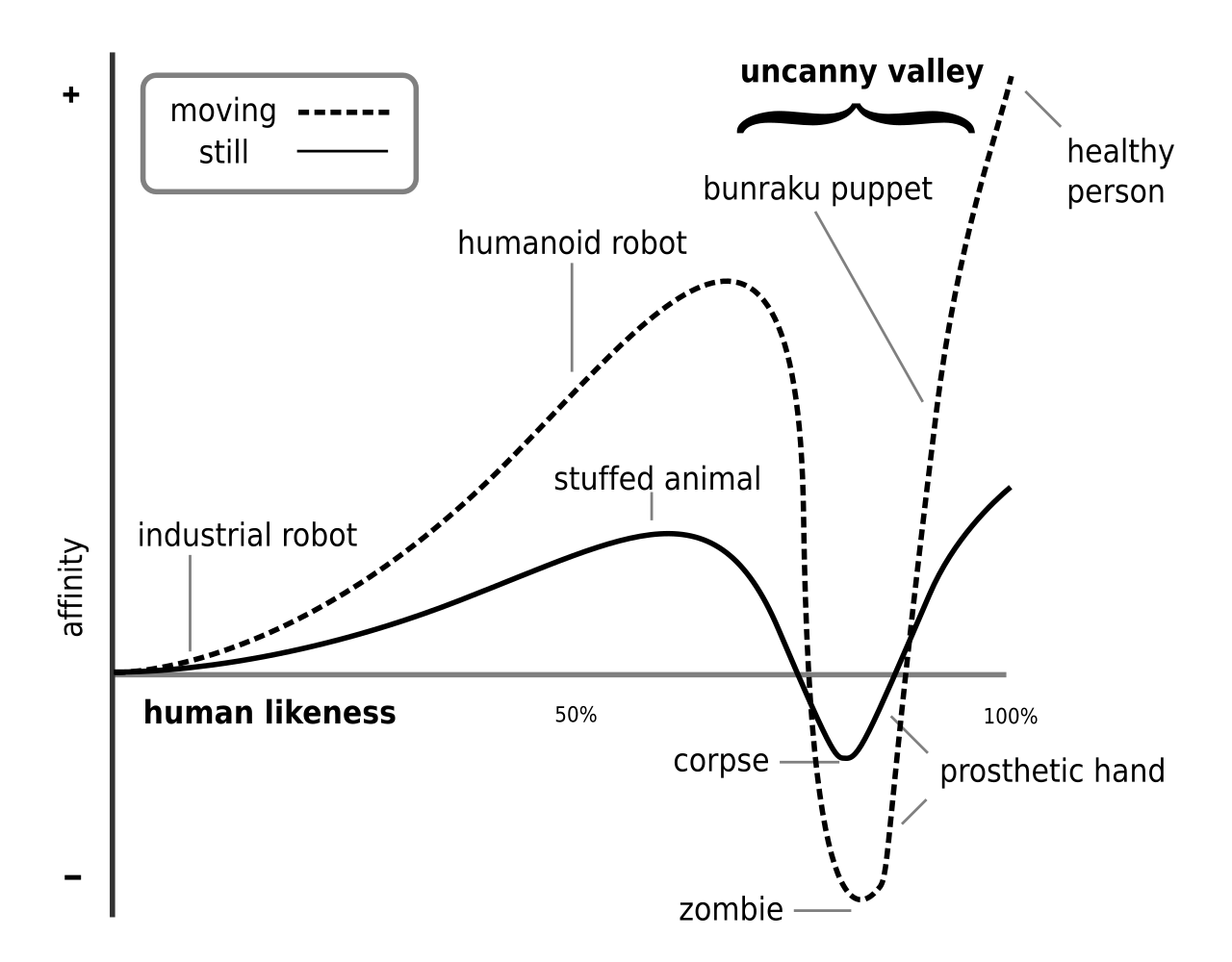
Graph: Smurrayinchester, CC BY-SA 3.0, via Wikimedia Commons
A simple template for a small business is fine. Nobody's fooled. A site thought through by people who know the business earns trust. And in between sits the AI-built site, with its polished layout and its perfect photos and its confident headline, looking for all the world like an established company, right up until you read it, and the copy says a lot and means nothing, and every section looks like the last one, and there isn't a real person or a single thing only this business could have said.
Nearly right.
It looks like a real business. It doesn't feel like one.
That's the uncanny valley of websites: every signal of a polished business, and nothing behind it that feels like anyone actually decided anything.
Field put it well: "People pick up on it. Whether they can articulate it or not, they can tell."
And most of them won't tell you. They'll just leave.
What that looks like in practice
A client came to us recently with a site built almost entirely with an AI website builder. It was big. Extensive, lots of pages, and at first glance it looked the part.
But so much was missing. And they work in a field close to healthcare, where trust is everything. To their audience, the site was repellent. They didn't realize until after launch how much handing the whole process to AI had cost them.
The trust problem goes beyond websites, too. Washington State University researchers tested product descriptions on more than 1,000 US adults. Just mentioning "artificial intelligence" made people less likely to buy, because it lowered their emotional trust. The effect was strongest on expensive or risky purchases.
We're not throwing that client's site away. We're using what the AI produced as raw material and putting the humanity, buying psychology and trust back in.
Humans buy from humans. They always will. It's the same instinct that makes people trust a polished site over a shaky one, which we've covered in Does your website design affect conversion rate?
The questions AI can ask, but can't answer for you
If you've built something with AI and want to know which side of the valley you're on, start here.
Does the first screen say what you sell, and who it's for, in words a customer would use?
Is there proof that's actually yours? Real photos, real reviews, real names.
Does every page point to one clear next step?
Would a stranger hand over their card details here without a second thought?
Has a real customer tried to use it while you watched?
If you can't answer yes to all five, the site isn't finished. It's a good draft. An audit is the quickest way to find what's missing.
Experience is worth more than ever
AI has hit design jobs hard, especially junior and mid-level roles. I have real sympathy for anyone starting out now. It's one of the hardest times there's been to get the experience this work needs.
Because the experience is the part that hasn't changed. How people buy. Why they hesitate. Where usability breaks, and what the psychology behind a page is doing. None of that came from a tool, and none of it got easier to learn.
It's worth more now. There's so much slop that the people who can filter it out are the ones who make the difference. Put that experience in charge of the AI and it becomes leverage. Better work, faster.
When you run an online business, you don't want the floor. You want everything the site can do.
It takes an afternoon to make a website look good enough now. It still takes years to know what's wrong with one.
What to do next
Use AI for ideas and drafts, not for the site your sales depend on.
Run your site through the five questions above before it goes live.
Ask whoever builds it why each choice was made. If they can't tell you, nobody thought about it.
Ben Laurence
Founder of Edge Gen. 20 years designing websites that have to sell. Startups, global brands, plenty in between. Writes about what moves the numbers, and what doesn't.


